Monday, 24 October 2011

Personal health budget pilot - 4th interim report - Department of Health

Personal health budget pilot - 4th interim evaluation report

"Early experiences of budget holders" interviews 58 budget holders in the pilot about their experiences of personal health budgets after three months. The report is positive overall, with some people already experiencing improved health outcomes. Key findings include that the role of information is key; and those eligible for NHS Continuing Healthcare tended to find the process easier, and reported benefits earlier.The report does highlight some issues which will need to be resolved and detailed work is underway to explore these and develop best practice that the NHS will need to deliver personal health budgets in the longer term.

Documents

The Department of Health have just released a number of videos of people talking about their experiences of Personal Health Budgets. From 2014 everyone will have the right to ASK to have to have a Personal Health Budget.

See the videos here http://www.personalhealthbudgets.dh.gov.uk/About/Stories/

Thursday, 20 October 2011

We need to relax regulations to stimulate creativity in Social Care - Guardian

We need to relax regulations to stimulate creativity in social care

A new 'map' aims to help 'micro-enterprises' avoid the pitfalls of government red tape
Providing meals to neighbours can involve a rigorous inspection of your kitchen. Photograph: Alamy
Companions is a micro-enterprise: a tiny domiciliary care service set up after workers consulted with a small group of older people and found that, although they were receiving care in their homes, they really wanted support to visit their friends because bus travel was proving too difficult.
So carers working for Companions planned to use their own cars to take people out and about. The snag was that the local council regarded the proposed service as a minicab firm, requiring an expensive licence and training.
The more creative people are about meeting needs, the more likely they are to run up against regulations not designed with them in mind. And in the past, problems affecting social care that were not fixable by the Department of Health have lain unresolved.
However, charity Shared Lives Plus, the DH and the Department for Business, Innovation and Skills are jointly launching a "map" for very small social care "micro-enterprises", setting out some useful steps forward involving a range of government bodies.
The map draws on new guidance for transport providers, making clear that when parliament tightened up safety laws around minicabs, it didn't envisage those regulations stopping a care worker giving someone a lift. The guidance includes some simple questions that social care businesses can ask themselves to decide whether they are primarily a transport business, in need of registering as such, or primarily a social care provider, likely to have much better ways of ensuring safety and quality than learning the licensed taxi drivers' "knowledge".
When clarifying grey areas of legislation, you risk getting the opposite answer to the one you hoped for. Some micro-entrepreneurs providing hot meals to older neighbours report inspections of their family kitchens more appropriate to restaurants. Confusion remains over the correct application of food business regulations to home care services, but the Food Standards Agency is now looking at this issue as part of a much wider red-tape review.
Likewise, while there are plans for portable criminal record checks, difficulties for self-employed support workers in obtaining enhanced checks are not immediately fixable. At least the government now has a clear understanding of this issue, and local quality-assurance schemes for sole-traders working in social care have been able to include police checks as part of the membership process.
The map also charts some particularly foggy territory around the tax and legal status of social care workers designated as "self-employed". Personal assistants – workers paid and managed by someone with a direct payment – are in fact nearly always employees, with sick pay and minimum wage rights. Employers wrongly advised on this have been pursued for unpaid national insurance contributions.
Sole-traders, however, particularly if they offer a set service to a number of people, may indeed be considered self-employed in some or all of those working relationships. It is even possible for someone to be considered both self-employed, for tax purposes, and employed, by insurers, or self-employed in one working relationship and employed in an apparently similar situation.
Small enterprises will remain in need of expert individual advice. But the new map should help social entrepreneurs and holders of direct payments avoid some of the pitfalls, while also offering a model for how the sector and government can work together to ensure that regulation catches up with the sector's creativity.
• Alex Fox is chief executive of NAAPS, the network for family-based and small‑scale ways of supporting adults. The map for microenterprises is available at naaps.org.uk
http://www.guardian.co.uk/society/2011/oct/19/relax-regulations-stimulate-creativity-social-care

Personal budgets alone do not democratise care - Guardian

Personal budgets alone do not democratise care

Following care home scandals such as Winterbourne View, personalising care services is even more firmly on the agenda but personal budgets are not the only way to achieve this
Personalising care means giving care home residents the chance to decide how they spend their time
Following the collapse of Southern Cross and the abuse scandal at Winterbourne View, many are calling into question the future use of residential homes for those who need care and support. In the modern care system, where independence and empowerment are the order of the day, the traditional nursing home doesn't seem an easy fit.
But residential care – by that I mean care settings which include some accommodation component – will always be necessary and, more importantly, in demand. Residential care of the future may not look like the traditional "care home", and they may not support the same numbers of people as they do now, but residential care settings – be that extra care, small units, shared lives or hybrid care/extra care homes – will always be a vital source of support, particularly for those with complex needs.
If we accept this fact, then a potential difficulty arises. How can this sector be compatible with the government's personalisation agenda? Personalisation, for the government, is essentially interchangeable with the concept of personal budgets and it has set a target of 100% take-up of personal budgets by 2013.
This means individuals given a personal budget will be tasked with purchasing an individual package of care to meet their needs, bringing together traditional elements of care with other services such as transport, leisure or social activities. The practical difficulties of achieving this in collective care settings are immediately obvious. How can a person living in a residential care environment (of whatever form it might take) purchase individual support from the on-site care team? How can the individual buy in a wider range of services (everything from a chiropodist to alternative therapies) when living in a care home? How can the individual dictate their social and leisure activities based on their purchasing power, when social activities are delivered and arranged collectively on site?
Of course these things are possible, with a lot of effort on the part of the residential care staff and reorganising the services of the entire resident population.
Dee View Court, a Sue Ryder home for patients with neurological conditions in Aberdeen has undergone something of a democratic revolution, with residents making decisions about everything from which staff are recruited to how communal space is used. But it's clear that when personal budgets were first conceived, they were seen as an individual consumer tool and a path to independence. This is perhaps demonstrated by the fact that direct payments (the cash form of personal budgets) are not yet available in care homes (a legal anomaly that the Law Commission has proposed to close as part of its single care statute).
So the big question for government now is how to square the circle – how to push forward the personalisation agenda, while recognising that some care populations, including those in collective care settings, palliative care and others – may not adapt easily to the primary method of achieving personalisation: the personal budget.
The answer seems self-evident. Personal budgets are life-changing, no doubt, but they are a fundamentally individualistic tool. They work best when an individual is co-ordinating a single package of care without the constraints of group living or sharing of services. Rather than trying to retro-fit personal budgets into collective care settings, therefore, we must embrace alternative paths to personalisation.
Co-design of services, democratic structures, imaginative use of collective spaces to encourage greater independence within care homes are all viable ways of turning care homes from sites of collective disempowerment and passive service use into "micro-communities", which, very much like housing co-operatives, are run by a powerful residents' association to ensure services are organised and meet the needs of the collective. Such settings could even be compatible with the pooling of personal budget funds. Of course, individuals may have to give way to the majority now and then – but this natural give and take of human society is a far cry from sacrificing one's individual preferences due to management diktat and organisational routine.
Until the government shakes its fixation with personal budgets as the only and most effective method of achieving personalisation, however, these alternatives will remain fatally under-developed. And as personal budgets are rolled out, personalisation will increasingly become an exclusive right to be enjoyed by the few, rather than the many.
• Claudia Wood is the author of a new Demos report on personalisation, Tailor Made

How to personalise social and health care by integrating services - Guardian

How to personalise social and health care by integrating services

The Dilnot commission's plans for reform of social care funding appear to have stalled, but a new focus on joining up services could produce big savings. David Brindle reports
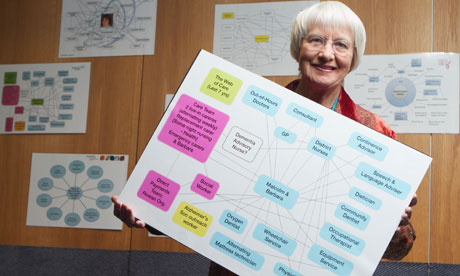
Barbara Pointon with chart on husband's care
Barbara Pointon with the chart she drew to demonstrate the agencies involved in her husband's care. Photograph: Sam Friedrich
There's nothing new about the aspiration of integrated health and social care services. But with hopes fading of any early implementation of the Dilnot commission's plan for reform of social care funding, the focus is shifting to integration as the means not only to deliver better, more personalised care to people, but also to make better use of resources already in the system.
The integration drum is being banged loudest, and with most effect, by Stephen Dorrell, chair of the Commons health select committee and a former Conservative health secretary. While the present holder of that post, Andrew Lansley, remains preoccupied with his controversial English NHS reforms – social care accounted for just 27 words in his 1,900-word address to the recent Tory conference – Dorrell is on an altogether different trajectory. The real policy challenge, he says, is to understand that it is only through integration of services that the needs of the 15 million people living with long-term health conditions can be met.
Dorrell's consistent message in a series of speeches at fringe meetings at the Tory conference was that integration should have top priority. "It's certainly more interesting than designing the bureaucratic structure," he said at one event, in what could have been taken as a subtle dig at Lansley. "How you drive integrated services with a disintegrated commissioning process is a simple question that cannot be put too often."

Patient voice

The health select committee is launching an inquiry into adult social care, with written evidence due by next Wednesday. Dorrell himself is an opening keynote speaker at the start of the National Children and Adult Services Conference, the headline event in the social care calendar. The conference is being held at the ExCel centre in east London, and there will be huge interest in what Dorrell has to say.
Among those taking a particular interest will be National Voices, the coalition of 130 health and social care charities working to strengthen the patient voice, which, in evidence earlier this year to the government's listening exercise on its health reforms, spelled out the three priorities for the care system as "integration, integration, integration". The group is currently developing a set of principles for integrated care, based on the experiences of people who have had to find – and often fight – their way round what it calls the "web of care".
One such person is Barbara Pointon, whose husband, Malcolm, lived with Alzheimer's disease for 16 years until his death in 2007. Their struggle was portrayed in a powerful television documentary, but the chart that Barbara has drawn to trace all the professionals and agencies involved in Malcolm's care and support, and the lack of co-ordination of their input, offers an equally shocking insight into what people with long-term conditions and their carers can be up against.
The benefits of integration for individuals look obvious. But what of the potential savings? Especially in the present public spending climate, this is critical.
Diabetes is arguably the biggest single challenge facing the health service. An estimated 3.6 million people are living with the condition, consuming 10% of the entire NHS budget, and numbers are forecast to grow to 5 million by 2025. New research findings for umbrella group London Councils suggest that adopting an integrated approach across the capital to health and social care services for people with type 2 diabetes could save as much as £190m.
Liz Kendall, newly appointed Labour shadow minister for care services and older people, says: "If we can get it right for diabetes, we can get it right for all conditions."
Delivering integration will, however, require a fairly abrupt gear-change on the part of a social care system that for the past three years has been concentrating on the task of giving personal budgets to those entitled to state funding. It is now just 18 months until all those eligible should have their own budget, whether taken in the form of a direct payment or simply allocated in notional form on paper. But a report published today – The Future of Personalisation for those with Complex Needs – calls for a rethink of this approach.
According to the report, by the Demos thinktank in association with Sue Ryder, the charity supporting people with complex long-term and end-of-life conditions, personal budgets are not the key to true personalisation of services for all – especially many of those within Sue Ryder's remit – and "we must move away from the narrow focus on personal budgets and the mindset which assumes that without [them], personalisation cannot be achieved".
Personalisation can be realised by fostering a "personal touch" by care workers, the report says, or in care homes by involving residents in their design and running. But integration of services is crucially important and social care, health and housing are "unlikely to come together in a seamless package through the force of an individual's purchasing power alone. Additional steps will need to be taken".
The report recommends that joint health and social care outcomes should be set by the local health and wellbeing boards planned under the government's NHS changes and already being set up in shadow form across most of England. Responsibility for delivering the outcomes would rest with clinical commissioning groups and local authorities.
Much is expected of these boards, but they do hold out the prospect of being able to make integration work. As Jules Pipe, chair of London Councils, puts it: "Health and wellbeing boards have enormous potential to bring together the knowledge, expertise and experience that has previously sat across a number of local agencies."
http://www.guardian.co.uk/society/2011/oct/19/personalise-health-care-integrating-services

Burstow: Government still committed to care funding reform - Community Care

Burstow: Government still committed to care funding reform

Jeremy Dunning
Thursday 20 October 2011 12:31
The government has not gone cold on reforming adult social care funding because of the £2bn-a-year cost of implementing Andrew Dilnot's reforms, care services minister Paul Burstow has insisted.
Speaking at the National Children and Adult Services Conference, Burstow insisted the government was committed to reforming adult social care because there was a "clear compelling economic case."
"Taking steps to reform now can prevent caring for the elderly becoming a brake on the economy," said the minister and added: "How we pay for care is critical. It's one we are determined to resolve."
However, he was careful not to commit the government to implementing Dilnot's recommendations and instead said the work of the Dilnot commission pointed out ways that care could be paid for.
The government's response will come in a White Paper next year, which it is currently conducting an "engagement exercise" to inform its proposals. In a session today at the conference, Dilnot said he was confident that the government was still committed to care funding reform, and said the suggestion that the reforms were unaffordable was "simply wrong".
Burstow said that adult social care had been cut by 1% in 2011-12, much lower than the 4.7% overall estimated cut in resources for local authorities this year, suggesting councils had protected the service.
However, the minister attacked the way some authorities had gone about making cuts.
Burstow admitted he was "concerned" that a further six authorities had set their eligibility criteria at critical in response to the budget cuts.
And he castigated some councils for making decisions on which services to cut based on "hopeless short-termism" rather than redesigning services to focus on prevention and early intervention.
He also called for the pace to be picked up on rolling out personalisation and for greater take-up of personal budgets through direct payments.
"There are still too many people who could benefit from personal budgets or direct payments and are missing out," he said as he called for a "spotlight" to be shone on councils that were performing poorly on personalisation.
Burstow added that the Department for Work and Pensions was set to publish a document on options to replace the Independent Living Fund, which is due to be scrapped in 2015, and the role that local government could play in any future arrangement.
http://www.communitycare.co.uk/Articles/20/10/2011/117633/Burstow-Government-still-committed-to-care-funding.htm

Personal budgets emphasis risks excluding complex needs - Community Care

Personal budgets emphasis 'risks excluding complex needs'

Mithran Samuel
Wednesday 19 October 2011 10:36
The emphasis on providing personal budgets for all risks failing to deliver personalised care for people with the most complex needs, a report from Demos warns today.
The study, sponsored by Sue Ryder Care, warned personal budgets in general and direct payments in particular may not be the most effective way to provide personalisation for groups including people with palliative care needs, with reduced capacity or in collective settings.
It raised concerns that the government's target of having personal budgets for all council-funded service users in England by 2013 risked "excluding those less able or willing to engage with the personal budgets process from the personalisation agenda".
Calling for a "personalised approach to personalisation", it said a wider range of approaches should be adopted beyond personal budgets to ensure person-centred care for all.
Those with the most complex needs often needed services that cut across health, social care and housing, which it was difficult for personal budgets to integrate, found the report.
The government's emphasis on having most people on direct payments risked excluding those who lacked capacity and leaving other types of personal budget - such as those managed by councils, providers or families - under-developed.
Although it said personal budgets could work in residential care - as the government intends - other ways of personalising care could be pursued such as giving residents a democratic say in the running of homes.
It said relationships with staff were key to delivering personalised care for those with the most complex needs, highlighting the importance of reducing turnover and a positive staff culture that encouraged risks and choices on the part of service users.
It also pointed out that specialist palliative care was the "gold standard of personalised care" despite personal budgets being difficult to administer in these settings.
The report's recommendations included:
● For providers to receive support to transform their financial systems to enable them to offer service users individual service funds to give them choice over their support.
● More training for staff in helping people make decisions towards the end of life.
● Increased support to help people move from residential care into supported living.
● Giving care home residents the right to have a say over key aspects of homes' running, including recruitment.
● For recruitment and retention policies to prioritise an enabling and empowering attitude on the part of staff and good relationships between staff and service users.
The report is being released at the National Children and Adult Services Conference, which opens today.
http://www.communitycare.co.uk/Articles/19/10/2011/117625/personal-budgets-emphasis-risks-excluding-complex-needs.htm

Councils on track for 2013 target of Personal Budgets for All - Community Care

Councils on track for 2013 target of personal budgets for all

Mithran Samuel
Wednesday 19 October 2011 00:01
Councils are on track to meet the government's target of having all service users on personal budgets by 2013, a survey has found.
Ninety-seven per cent of authorities say they are on course to meet the target, which applies to users of ongoing council-funded support, found the survey by the Association of Directors of Adult Social Services.
Released for this week's National Children and Adult Services (NCAS) Conference, the survey found 40% of councils already had 60% of users on personal budgets and three athorities were on course to reach the 100% mark by the end of 2011-12.
The target was set in last year's government vision for adult social care.
"The findings suggest that the [vision] has given the sector the autonomy and confidence to lay the foundations of creative, varied local practice and sector-led improvement on personalisation by councils, some of which has the potential to be scaled up and transferred," said Adass. "The sector will now need to look at how it supports the transfer of good practice across local government."
The government envisages that most personal budget holders will be receiving a direct payment by 2013.  However in 2010-11 most of the growth in personal budgets came in the form of council-managed budgets.
Adass's latest survey found that councils were proactively promoting direct payments to increase numbers.
However, it also found that some councils were struggling to extend brokerage and advocacy services to self-funders and recommended that more work needed to be done on extending these services.
In his speech to the conference today, Adass president Peter Hay will acknowledge that councils "have a long way still to go in creating an information and support offer to all".
But he will say: "We have implemented a whole new model for care – moving away from the tight constraints of a system set solely by eligibility, to one that includes enablement and prevention. Within this model councils are pushing further – ideas like enablement running through the lifetime of care, payment by outcomes, and rewarding those who minimise reliance on care."
Six councils either did not respond, or did not provide sufficient information to allow for further deductive analysis.
http://www.communitycare.co.uk/Articles/19/10/2011/117623/councils-on-track-for-2013-target-of-personal-budgets-for-all.htm

Restrictions on use of Personal Budgets must be lifted, say sector leaders - Community Care

Restrictions on use of personal budgets must be lifted, say sector leaders

Mithran Samuel
Wednesday 19 October 2011 00:01
Restrictions on how service users spend personal budgets should be lifted, say sector leaders.
A string of reports published this week by Think Local Act Personal, the sector coalition set up to support the delivery of personalisation, describes councils' approach to implementation as over-restrictive and mistakenly introduced to save money.
This has restricted creativity and efficiency, said TLAP programme manager Martin Routledge. "They have other means of controlling how money is allocated, they don't need to place conditions on people."
Outcomes for service users on personal budgets were generally better when they were relatively free of constraints on how they spent money, found the TLAP-commissioned National Personal Budgets Survey published earlier this year.
In particular, TLAP wants to see restrictions lifted on the use of direct payments in order to increase take-up. The personal budgets survey found that people on direct payments enjoyed better outcomes in general than those on council-managed personal budgets.
However, nearly all of the increase in personal budget numbers in 2010-11 in England came in the form of council-managed budgets, according to a separate survey by the Association of Directors of Adult Social Services.
Routledge said the government's target of having all people on personal budgets by 2013 with a significant proportion on direct payments was "clearly a challenge" on current trends.
http://www.communitycare.co.uk/Articles/19/10/2011/117620/cut-bureaucracy-for-service-users-councils-told.htm

Social workers support planning role must be cut back - Community Care Magazine

Social workers' support planning role 'must be cut back'

Mithran Samuel
Wednesday 19 October 2011 00:01
Social workers' role in support planning should be radically reduced so that service users can take control of deciding how to spend their personal budgets, an influential paper said this week.
The report for Think Local Act Personal, the sector coalition set up to support the delivery of personalisation, said the default position that care managers supported people to develop a support plan needed to be reversed.
"Requiring that people always have professional interventions in order to perform what for many can and should be a relatively simple task, is fundamentally disempowering as well as inefficient and costly," it warned.
The latest news from the National Children and Adult Services Conference
The assumption should be that people will make their own plans with the aid of simple tools, said the report by personalisation consultants Helen Sanderson and Simon Stockton.

Where they did need assistance, this should be designed to transfer support planning skills to them and enhance their confidence, and should often be provided by external organisations.
It said there was good evidence that external support planning services, such as those provided by user-led organisations, were better at helping people take control than council care managers.
A key factor in making the model work was for councils to provide eligible service users with their personal budget without having a detailed support plan in place, leaving users with the time to develop this subsequently.
The paper has been endorsed by TLAP's board, which includes the Association of Directors of Adult Social Services, the Department of Health and the Social Care Institute for Excellence.
TLAP programme manager Martin Routledge emphasised that it did not want to see the number of social work jobs decline or for professionals to play a lesser role in the support system overall.
He admitted some social workers felt they were being "written out of the script" on personalisation and that TLAP and others needed to focus on "more positively describing the role of social workers in self-directed support".
In terms of support planning, he said: "Social workers will need to focus their efforts on those people who really need it." Some people would be able to do this for themselves, he added, while others would be able to gain help from a user-led organisation; "but there will be a significant number of people who will need some support from social workers".
This included people with more complex needs and those who were isolated.
Routledge added that his personal view was that there was scope for an expansion in community social work with practitioners developing networks to help disabled and older people manage their support.
Sanderson and Stockton's model is similar to the "new script for social work" developed by think-tank the Centre for Welfare Reform.
Although social workers play a reduced role in support planning under the "new script", they are given increased freedoms, notably being able to sign off personal budgets up to a certain value.
http://www.communitycare.co.uk/Articles/19/10/2011/117619/cut-social-workers-planning-role-to-empower-users.htm

Councils urged to sign up to new personalisation indicators - community care

Councils urged to sign up to new personalisation indicators

Mithran Samuel
Wednesday 19 October 2011 00:01
Councils and providers have been urged to sign up to a new suite of indicators on personalisation and publish details of their progress against them.
Sector coalition Think Local Act Personal has drawn up a series of markers in consultation with users and carers to define what successful personalisation looks like.
The "Making It Real" markers replace the milestones established by the last government to track progress on personalisation from 2008-11, which included having 30% of users and carers on personal budgets as of April 2011. The new set includes the coalition government's target of having all users of ongoing council-funded support on personal budgets, preferably as direct payments, by 2013.
More news from the NCAS conference
The indicators will not be compulsory but the Association of Directors of Adult Social Services will be encouraging members to use them and they will be expected to form part of local reports councils are due to publish from this year on their performance in adult care.
The Department of Health will also use them to inform the development of its national adult social care outcomes framework.
Besides the Making It Real process, TLAP will be carrying out a survey of service users next year to build up a picture of national progress on personalisation by next summer.
The indicators
● Everyone eligible receives ongoing council-funded support as a personal budget, in most cases as a direct payment.
● Self-funders receive the information and advice they need to have maximum choice and control.
● Direct payment users, self-funders and carers are supported in the recruitment, employment and management of personal assistants.
● Assessments are kept to a minimum, are portable, where possible, and do not cause difficulty or distress.
● Staff have the values, attitude, motivation, confidence, training, supervision and tools to facilitate the outcomes users and carers want for themselves.

Direct Payments not reaching mental health service users - Community Care

Direct payments not reaching mental health service users

Molly Garboden
Monday 17 October 2011 11:23
People with mental health problems are being denied the benefits of direct payments because of a lack of staff knowledge and inadequate information from councils, a Rethink Mental Illness report has warned.
One hundred per cent of direct payment users surveyed by Rethink recently said that having a cash payment to fund their care needs had had a positive benefit on their lives. However, direct payment take-up rates for the client group remain low.
Just 15% of staff working for Rethink services felt their local authority has a good system in place to ensure people with mental health problems and their carers were able to access personalised social care.
Barriers included a lack of information from councils on direct payments, long waiting times for needs assessments and payments to be made, over-prescription from councils on how payments could be used and a lack of staff knowledge.
It said outcomes were generally better when:
• Information about direct payments was provided at an early stage and people were offered them rather than having to ask for them.
• People had a good relationship with their care co-ordinator, who helped them pro-actively through the process.
• Councils could safely manage issues of risk and capacity while maximising people's control over their support.
Rethink called for greater training for care co-ordinators in supporting people through the direct payments process and for councils to provide clear and independent information on personalisation and direct payments and to signpost users and carers to local support groups.
Case study
Sue Toms suffers from bi-polar disorder. She has been on direct payments through West Berkshire Council for five years.
"I use my payments for respite care and it's kept me out of hospital for the past four years, no doubt about it. I live with my husband and adult children and life at home can get incredibly stressful. With the payments, I can get away, just take a break and get out of the house. I don't do anything luxurious - I go to a local inn for three nights and chill out, listen to music, have some peace and quiet.
"I've been really happy with the direct payments system - it's a relief not to have to negotiate with the local authority. I can go where I like when I like and do what I want.
"One of the problems I've had recently is that my payments haven't gone up for the past two years, but the cost of my respite stays have. I've been told to do something cheaper, but I honestly can't find anything cheaper than the inn.
"So I would highly recommend direct payments to other service users, but with the warning that the cuts are hurting the system right now."
http://www.communitycare.co.uk/Articles/17/10/2011/117615/Direct-payments-not-reaching-mental-health-service-users.htm

Sunday, 16 October 2011

Day services for people with learning disabilities - consultation - RBKC

Day services for people with learning disabilities
If you have learning disabilities and would like to get involved in activities during the day, you can contact these local organisations for help. They can also help you with advice and support if you would like to go to college or get a job.

--------------------------------------------------------------------------------
Stop press October 2011
Tell us your views! Changes to day services for people with a learning disability.
The Council is consulting people who use Scope or the Community Action Team (CAT), their families and carers, organisations offering residential care and/or 24-hour supported living schemes in the borough, and other people who are interested.
It asks you for your views on proposals to change the day services offered by the Council for people with a learning disability, provided by Scope and CAT. It also tells you about some further work we are planning, to see how the organisations will be managed in the future.
Closing date for your views is 14 November 2011
For more information and how to contribute your views, please select either the full document below, or the easy-read version
Full document [PDF] (file size 272Kb)
Easy-read document [PDF] (file size 267Kb)
--------------------------------------------------------------------------------

Community Action Team
The Community Action Team will help you get more skills and get involved in your local community. They can help you if you would like to go to college or get a job. Visit the Community Action Team.
1-9 St Mark’s Road
W11 1RG
Phone: 020 7313 6879

Full of Life
This organisation is run by parents of people with disabilities. It provides support and events for carers as well as for children and young adults. This includes a programme of events and activities which run over the summer such as trips to theme parks and zoos as well as music, drama and sporting activities in the local area. They also run after school and Saturday clubs which provides young people with the one-to-one support they need to work and play.
For young adults (aged 18 to 25) with complex needs and "in transition", the service is provided in the evenings, on Saturdays, during half terms and during the Christmas, Easter and Summer holiday period.  Visit Full of Life.

Unit 7,
Buspace Studios,
Conlan Street,
W10 5AP
Phone: 020 8962 9994

Equal People
Equal People runs a centre where you can go during the day to join in activities, including arts and crafts, storytelling and a gardening group. There are also social clubs where you can meet other people, and a café. Visit Equal People.
Here are the services they offer:
Activities Service
Offers a variety of different activities throughout the week where you will get help, both at the resource centre and out in the community.
"Drop-In"
Just turn up! The resource centre is open Monday to Friday 9.30am to 5pm. People can come to relax, meet with friends or seek advice.
Transition Service
Support for young people aged between 14 and 25 to find out about the choices they have for their future, and to link with the people who can help them achieve their wishes. There are weekly group activities and there is an organized activity programme during college holidays.

Community Support Service
Offers one to one support to access the community, provides activities, and manages health and medication. Home care is available. Support can be purchased through Individual Budgets, Direct Payments or via social services. Contact Equal People for more information.
73 St Charles Square
London
W10 6EJ
Phone: 020 8964 0544

Scope Resource Centre
Scope is a day centre for adults with learning disabilities. If you have learning disabilities and need a lot of support, you can get help with making friends or going to college from the Scope Resource Centre. The centre can help you get involved in dance and movement groups, exercise classes, using the internet and other activities.  Visit the Scope Resource Centre.
1–9 St Mark’s Road
W11 1RG
Phone: 020 7313 6879

Pursuing Independent Pathways (Westminster)
PIP works with adults with learning disabilities to promote independence and choice. They are based in Maida Vale and Victoria. Their projects focus on:
supporting independent choice and self advocacy
training for work skills and providing job opportunities
developing independent living skills
support to take part in further education
travel training towards independent travel
personal development
Visit Pursuing Independent Pathways (Westminster)
 

Care and Fun for Carers - 29th October - Carers Network

Care and fun for carers10 October 2011
Do you care for someone and need extra support? The Royal Borough is encouraging carers to come forward and take advantage of its support services.
To find out how the Council can help, come along to a free event on Saturday 29 October from noon to 5pm at the top floor of Portobello Green Fitness Club, 3 to 5 Thorpe Close, W10 5XL.
The event, run by Carers Network Westminster, will offer live entertainment, art workshops and refreshments for all, including young carers.
Can't make this event? Sign up for a range of free outings, including a screening at the IMAX Cinema, a Big Bus Tour or an evening at the Natural History Museum. To book, contact Susie Yau on 020 8960 3033 or email susie.yau@carers-network.co.uk
Carers Champion, Cllr Gerard Hargreaves, said: "Caring for someone is a huge commitment and involves a lot of time and effort. Many carers are already in touch with the Council, but I want to make sure that all carers know they can come to us for information, advice and practical support."
From social activities and support groups, through to counselling and benefits advice, the Council funds a range of services for carers. If you provide regular care you may also qualify for a personal budget to support you in your caring role.
If you need support, telephone Carers Kensington & Chelsea on 0800 0321089 or email kandc@carersuk.org

Hardest Hit October Rally 22nd October 2011

Take action this October
Following our protest in May, when an estimated 8,000 people marched on Parliament, further events are taking place across the UK this month. These events are designed to raise awareness amongst the general public, the media and politicians of our key messages.  Click here to find your nearest event.
Regardless of whether or not you are able to attend one of the events taking place on October 22, 2011, there are still lots of ways you can get involved to support this campaign. We need your help to really make an impact. It won’t take much time out of your day, but it will make a massive difference to the success of our campaign.
You can:
1. Write to your MP and invite them to attend their local event. We want as many MPs to know what’s about the campaign as possible.
2. Lobby your MP in the week leading up to the event by attending a constituency surgery or writing to your MP, you can help make sure that they are aware of our campaign and the arguments against welfare reform.
3. Write to the editor of your local newspaper. By doing this, you are helping us advertise the events and making sure that as many people as possible know they are happening.
4. Send a Press Release to your local paper, not only will you be sharing your concerns about Government cuts but making sure that as many people as possible know the event is happening.
5. Be a case study. Your story is the most important. Tell decision makers and the media why you support this campaign and help us show the human face of welfare reform.
Events taking place on October 22

London
Saturday 22 October, 2011
Rally 11am – 1pm
Outside the GLA Building (City Hall), Queen’s Walk

Disabled people in London, along with their families and friends, are taking to the streets in London to protest against Government cuts to disability benefits and services.  Join us and help to make sure all our voices are heard.
The rally is taking place outside London’s iconic GLA building (City Hall) on Queen’s Walk.  Dartford band Rush Hour will keep us entertained from 11.00, with speeches from 11.45, plus there will be the opportunity for you to make your voice heard.
We plan to have a range of speakers who will keep us informed and entertained.  Confirmed so far is Chair of Inclusion London, Kirsten Hearn, Cllr Darren Johnson AM, and Jennette Arnold AM for North East London and Chair of the London Assembly.  We also have a statement from John Biggs AM for City and East who sadly can’t join us.
There will also be the chance to hear the experiences of local people talking about what the proposed cuts to benefits and services will mean to them as disabled people trying to live independent and fulfilling lives.  If you would like to be one of those having your voice heard there will be a chance on the day for you to tell us what the changes mean to you.
For a detailed map of the area, including public transport links click here.  The nearest tube is London Bridge which is served by the Jubilee and Northern lines.  If you would like help in planning your journey then the Transport for London website has a journey planner that covers all public transport options: http://www.journeyplanner.org/.  Details about the accessibility of different types of public transport can be found here.  There are limited opportunities for parking in central London.  For details of where to park and how the blue badge scheme operates in Westminster click here.
This gives advice on the different parking regulations in force and has a link to the Blue Badge London website that has a searchable list of the parking available.
As new speakers and contributors are confirmed we will be adding them to this page, so do keep an eye out for any changes.  Please also help us spread the word about Hardest Hit.  London is one of many cities across the South East that have been severely affected by budget cuts.  Across the region people are seeing deep cuts in services such as social care and transport, which they rely on to remain independent.  Please come along, and bring as many friends and family as you can.  Help us to send a clear message to the Government: stop these cuts.
To register your interest in the rally please email: london@hardesthit.org.uk or call 020 8522 7433

Several ADKC members and staff will be going on this rally - if you want to attend but want to meet up with ADKC members, let us know and we will arrange a meeting place
 

Conservative conference: Personal health budgets ‘will boost rights’

Conservative conference: Personal health budgets ‘will boost rights’

Tens of thousands of disabled people who receive “continuing care” from the NHS could benefit from new government rules that should allow them more control over how their needs are met.
Those receiving NHS continuing healthcare – free care outside hospital for those with complex health and social care needs – will have the right to ask for a personal health budget by April 2014.
Health secretary Andrew Lansley told the Conservative party conference that personal health budgets – a pot of money that can be spent by an individual on any support that meets their agreed health and wellbeing needs – would allow people “to choose support and services that suit them and their families”.
But the Department of Health (DH) stressed that personal health budgets would only be rolled out across the country “subject to evaluation” of a series of 20 pilot projects, which are due to end in October 2012.
And NHS managers will still be able to turn down a request for a personal health budget, if it is not felt to be “appropriate” or “suitable” for that person.
One of those who welcomed Lansley’s announcement was Valerie Garnham, who last year lost a legal battle for the right to use direct payments to manage her long-term condition.
She said: “It is not for everybody, but you should have that choice, you should have the option if you have enough energy and are well enough to do it.
“I have said all along that it should be a human right to choose how and where and by whom you want your help delivered.”
She said it made “no economic sense” to use expensive specialist agencies to deliver continuing care, rather than offering people direct payments. She has been told it would cost three times more to deliver her care through an agency than it does for her to organise it herself.
She and another disabled person, Steven Harrison, were forced to drop their appeal when the DH introduced new laws that only allowed direct payments for healthcare through official pilot schemes.
Garnham’s primary care trust, Islington, in north London, was one of the trusts selected to run a pilot scheme, so she has been able to continue managing her own healthcare.
But it is believed that Harrison, from Yorkshire, has not been able to continue using direct payments because of the court ruling.
Garnham’s solicitor, Frances Lipman, from Disability Law Service (DLS), welcomed the government announcement, which she said was “inevitable”, due to the rise in the use of direct payments and personal budgets by social services, although she said that 2014 was “a long time away” for many people with long-term conditions.
She said she had just given advice to a couple who called DLS’s advice line, and wanted their daughter to continue to provide support, through direct payments, after the husband moved from council-funded support to NHS continuing care.
But they have been told their daughter will have to join the local care agency used by their NHS trust if she wants to continue supporting her father.
The 20 pilot projects are testing the use of personal health budgets for people with long-term conditions, mental health conditions, and end-of-life care needs, as well as those receiving continuing healthcare.
Lansley said personal health budgets would be part of a “cultural shift for doctors, healthcare professionals, providers and patients, which sees the patient as an equal partner in decisions about their care” and would “provide more integrated high quality care across health and social care”.
6 October 2011  John Pring
http://www.bhfederation.org.uk/federation-news/item/1402-conservative-conference-personal-health-budgets-‘will-boost-rights’.html

Friday, 14 October 2011

Does your Personal Assistant / Care Worker need training?

RBKC is offering a number of reduced price courses that could be of interest for people who empoy their own Personal Assistants  or Care Workers

Health and Safety (with a particular aim at people in the Social and Health Care sector) - for more  information follow the link below
http://www.rbkc-thirdforce.com/compliance/foundation-health-safety-%e2%80%93-care/

A list of modules covered on the course can be found here http://www.rbkc-thirdforce.com/wp-content/uploads/2011/03/ymarketing_collateralfoundationhealthandsafety.pdf

The Control of Hazardous Substances may be of interest to people working with hazardous substances, including household products such as bleach and other cleaning products http://www.rbkc-thirdforce.com/hospitality-skills/coshh/

Finally, for those of you who have yor care worke assisting with meal preparation there is a "Level one award in Food Safety and handling" http://www.rbkc.gov.uk/businessandenterprise/regulation/healthandsafety/publichealthtrainingservice/foodsafetytrainingcourses/l1infoodsafetyawareness.aspx

If you are interested in any of these courses for your workers you MIGHT be able to use your Personal Budget to pay - I will update this post when I know for sure.

Update - Mark Ward of the SDS Team has said that if anyone is interested in having their Personal Assistants / Care Workers attend these courses that there MIGHT be a possibility of getting places for FREE.

Tuesday, 11 October 2011

Coming Soon - get your aids and equipment on prescription!

In August, RBKC announced that people would be able to receive a "prescription" for a small piece of equipment or aids, rather than having this piece of equipment provided by the Community Stores. (see article on the PB blog http://personalbudgetskc.blogspot.com/2011/08/rbkc-community-equipment-changes.html).

This would allow people not only  to get equipment, sometimes on the very same day, from a supplier that they trust, but also they would be able to "top-up" with their own money if they want something that looks less clinical (for example a patterned walking stick rather than just a plain wooden one!!)

ADKC is interested in being one of the authorised supplies meaning that, if this goes ahead, people could chose to come to ADKC to receive their particular aid / piece of equipment! The PB Team - Martha and Jenny H - will be finding out more about this "retail model" on the evening of 17th October. So watch this space to find out more information!

Saturday, 8 October 2011

Commons Health Committee launches inquiry into Social care - Consultation

Commons Health Committee launches inquiry into Social care
14 September 2011
The Health Committee has issued an invitation to submit written evidence for its inquiry into Social care.  The deadline for submitting written evidence is noon on Wednesday 26 October 2011.
The Coalition Agreement recognised the "urgency of reforming the system of social care" and the Government moved quickly to establish the Dilnot Commission with a brief to produce recommendations for the future funding of long term care.
The Government has also pledged to break down the barriers between health and social care, roll out personal budgets and to use direct payments to carers to improve respite care.
In parallel with the above developments the Law Commission published a report which makes far-reaching recommendations about the statutory framework for the commissioning and provision of social care.
The Government has committed itself to consider these proposals in discussion with all stakeholders during the Autumn of 2011 and has promised a White Paper on social care in 2012. It has indicated that legislative follow-up is likely in the next session of Parliament.

The issues

The purpose of this inquiry is to consider the issues facing the government as it prepares its Social Care White Paper, and make recommendations for consideration by the Government before the White Paper is published. The inquiry will focus on adult social care, particularly of those people of 65 years of age and older. The Committee will consider, amongst other issues:
  • The practical and policy implications of the Government’s plans for funding social care, and the recommendations made by the Dilnot Commission and the Law Commission
  • The scale and implications of existing variation in access to and charges for social care in England
  • The practical and policy implications of the Government’s commitment to promote personalisation of social care, including personal budgets and direct payments
  • The barriers faced by recipients of social care when they wish to relocate to another area, particularly with regard to the portability of assessments
  • Economic regulation of the social care system including a proportionate failure regime that can mitigate against the failure of social care providers
  • The practical and policy implications of the Government’s stated commitment to promote integration between health and social care services
The deadline for submitting written evidence is noon on Wednesday 26 October 2011.
http://www.parliament.uk/business/committees/committees-a-z/commons-select/health-committee/news/11-09-14-socialcaretorcfe/

Tuesday, 4 October 2011

How three London councils are joining forces - Guardian

How three London councils are joining forces

As councils grapple with cuts, Patrick Butler speaks to Andrew Christie, the first tri-borough head of children's services
Andrew Christie believes bringing three children's services departments together will minimise cuts to frontline services Photograph: Frank Baron for the Guardian
If he is awed by taking on one of one of the biggest, most managerially complex and politically high profile roles in local government, Andrew Christie is not showing it. Next week, the former social worker takes up the role of director of children's services for three London councils, helping to pioneer what the local authorities are calling a "radical reinvention" of the way councils operate, and delivering "a new dynamic way of running this part of our world city".
Drawn up over the past year as an explicit response to the drastic cuts in town hall budgets, the so-called "tri-borough" plan aims to merge the management and back-office teams (and some frontline services) of three Conservative-run inner London councils: Hammersmith and Fulham (where Christie has been director of children's services since 2006), Westminster, and Kensington and Chelsea. It is a grand version of what policy wonks and consultants call "shared services".
Christie's merged children's department is expected to deliver, proportionately, the biggest savings of this ambitious plan. Bolting together the three children's services departments means he will oversee a £500m budget and 150 schools, and commission scores of outsourced services, run by charities and staff "spin-out" mutuals. He doesn't seem fazed by the scale of the enterprise, pointing out that it is only half the size of Birmingham council's children's services.
Alongside the considerable managerial demands, however, he accepts that there are some uniquely demanding accountability issues. Each council will retain its democratic sovereignty under the plan, so Christie will have to deal with three different cabinet members, and three children's services scrutiny committees. Three times as many egos and agendas. "We are bringing together three different organisations, three different cultures. We have to work with three different sets of masters and mistresses. It's probably the most unusual characteristic and probably the most complicating aspect."
The shared service approach is not without its critics: there's evidence to suggest that few such projects deliver the predicted savings, and many end up costing more than the arrangements they replace. But Christie, as you would expect, is confident that the tri-borough model will deliver. The three councils are relatively small, he points out: if you were starting from scratch you wouldn't set up three separate children's services departments for an area of this size and demographic similarity. "I genuinely believe this is a way of delivering significant savings in management and back-office costs ... which helps minimise the impact on the kinds of savings we have to make on frontline services," he says.
Cost savings
The plan received the early blessing of the communities secretary, Eric Pickles, who said "these councils are leading the way", when it was first mooted last October. Since then, the hyperbole level has dropped a little: the initial projected savings of £100m over three years seem to have been downgraded, following detailed costings, to £35m.
Heady speculation that practically every service might be merged has been superseded by publication of a more sober assessment. Housing, planning, waste collection and a host of smaller services will not be integrated, or at least not for some time. The Pickles-friendly notion that the plan would enable three highly-paid chief executives to be replaced by one has been diluted: Westminster will retain its chief executive, the other two councils will share one.
The three councils, which between them spend around £1.5bn a year, calculate that government-imposed cuts in their budgets will create a £100m shortfall between now and 2015. The tri-borough savings plan, if achieved, would deliver a third of this, which is not to be sniffed at, although it hardly matches ministerial suggestions that sharing back-office services will eradicate the need to cut frontline services.
Christie believes that the merger will improve services, as well as save money. The three children's services departments are already high performing, he points out, but the merger will enable a broader range of more specialist children's services to be delivered in areas such as adoption and fostering. It will also allow some detailed benchmarking of services, he says.
"If councillors in authority A discover they are spending £100 per head more on a particular service but are getting no better outcome than authority B then, not unreasonably, council A will say, 'We want the same performance as council B.' One of the criticisms [of local authorities is that] we are poor at learning from each other and we all tend to go back and reinvent the wheel on our own. And that is partly because it is very difficult to really get to a comparable position," he says.
What about inter-borough variations in staff pay? "We do have to wrestle with the differentials that exist in terms and conditions ... Over a period of time we will inevitably move to an equalisation of those," he explains. "We have to recruit and retain good quality staff so we can't buck the market, but at the same time we have to be careful and cautious about public sector pay because the reality is there is no money in the coffers, so we cannot afford to make this inflationary."
Another obvious area for scrutiny is looked-after children. The three boroughs have broadly similar child populations but Kensington and Chelsea appears to manage demand on its care services much more successfully than the other two: it has 147 looked-after children; Westminster has 247, and a thousand more children in the system overall. "Is it a product of a different socioeconomic profile, which is quite possible, or is it a product of different practice?" asks Christie.
Child protection is left almost untouched by the tri-borough revolution (though change isn't ruled out in the future): each council will continue to have its own autonomous safeguarding teams. Christie says councillors were adamant they did not want major change in that area, on the grounds of risk. "Politicians are very cautious about child protection. Rightly, it's the absolute heart of confidence and reputation in any service. It's about life and death, so I think it's a sensible decision," he says.
Destabilising risk
"The risk in running any child protection service is if you implement change that isn't carefully thought through and carefully managed, you run the risk of destabilising the service. You run the risk of loss of morale and confidence, of loss of staff, which is a crucial thing in social work, and therefore a decline in standards."
Spending cuts, he expects, will continue: "Sometimes you think: 'We will run out of road.' But I don't see the current trend reversing. I think it will continue and we are just going to have to look for more and more efficiencies as we go along," he says. "So far we have risen to the challenge and so I have to say that all three councils have been very keen to protect frontline services and have been pretty successful in doing that thus far. I'm sure they will want to continue to make that a priority."
Does he think the round of cuts needed to balance next year's budget will start to impact on the quality of frontline services – that, after removing the fat, the councils will be cutting into bone? For a split second, the affable tone almost disappears: "No, we are definitely not. You want my frank appraisal? A lot of money was spent under the previous government without due regard to impact and outcome. And what we are having to do is get much smarter about what we are going to do with our money.
"If you look at the outcomes we are achieving in all three boroughs, they are still improving and they will be maintained at that level, or we will make further progress. You will have to come back and challenge me if I fail in that, maybe in a couple of years' time. That is not wishful thinking. I am confident we are able to do that."

Curriculum vitae

Age 57
Status Married, four children.
Lives Crowthorne, Berkshire
Education Manchester University, BA economics; Sussex University, MA social work.
Career 2011: director of children's services for the tri-borough partnership of Hammersmith and Fulham, Westminster, and Kensington and Chelsea; 2004-2006: director of children's services, London borough of Hammersmith and Fulham, 2004: director of borough children's trust; 1998-2004 assistant director posts, Hammersmith and Fulham; 1989-98: social work area manager, West Surrey; 1980-89: children's social worker in East Sussex, Australia and south-east London.
Public life London regional chair, Association of Directors of Children's Services; trustee, British Association of Adoption and Fostering; governor, Ealing, Hammersmith & West London College of Further Education
Interests Sports, including golf, snowboarding, mountain biking and cricket.

150,000 social care workers paid below legal minimum wage - Guardian

150,000 social care workers paid below legal minimum wage, research reveals

Study also uncovers arrangements between universities and businesses to make students pay for work placements

If hair salons make staff self-employed, they can avoid the minimum wage. Photograph: David Sillitoe
At least 150,000 workers in the social care sector may be getting paid less than the minimum wage, according to research by Kings College London.
A study of figures from one of the largest data sets on social care pay, reveals that around 9% or 110,000 care workers in England are being paid less than the minimum wage, five times the government's own estimate of the problem.
If the figures are extrapolated across the UK, this amounts to between 150,000 and 200,000 workers who are being paid less than the legal minimum, according to Dr Shereen Hussein of Kings College, an expert in pay issues in the social care sector. Office for National Statistics figures point to only 27,000 social care workers who are working below national minimum wage levels.
The research, to be revealed in Monday night's Panorama programme on BBC1, will also uncover arrangements between universities and businesses in which students must pay thousands of pounds to do nine-month work placements with British companies.
Currently, students doing this kind of work are exempt from minimum wage laws and do not have to be paid anything in return.
The programme is being aired as the government raises the minimum wage from £5.93 to £6.08 an hour. It also finds that in a time of economic stagnation employers are looking for a multitude of ways to undercut the legal pay requirement.
In a submission to the Low Pay Commission, the government quango that oversees the minimum wage, the National Hairdressers Federation said that in the past year alone 10,000 hairdressers had been recategorised by their employers as "self employed". Under the law, those who are self-employed do not have to be paid the minimum wage.
One hairdresser, Mark Coray, manager of Coray and Co, said that he had made a number of his staff self-employed to avoid paying holiday and sick pay, and PAYE tax. "It's almost like a legal way of avoiding the high overheads that come with the minimum wage," he tells the programme.
MPs and the fashion company Stella McCartney will also be targets of the programme for using unpaid interns.
Internship campaigner and the founder of the website Graduate Fog, Tanya de Grunwald said: "I am really glad that this issue is being tackled in a major way. It is an outrage that there have only been seven prosecutions of employers over national minimum wage law since its inception. It's about time someone stood up for young workers and graduates."

News -Personal Budgets boost for continuing care clients - Community care magazine

Personal budgets boost for continuing care clients

Mithran Samuel
Tuesday 04 October 2011 19:21
People with continuing healthcare needs will have the right to request a personal health budget by April 2014, health secretary Andrew Lansley has told the Conservative Party conference.
The move would help personalise the NHS and further integrate health and social care, said Lansley. However, health commissioners would have the right to refuse requests.
About 53,000 people receive continuing care at a cost of £2bn a year to the NHS in England; it is given to people whose need for long-term care is primarily the result of a health condition.
Personal health budgets, under which people with long-term conditions are allocated money to fund their healthcare, are due to be rolled out from October 2012 after the current pilot phase.
In the past, people have lost their right to direct payments after becoming eligible for continuing care because of the bar on the NHS making cash payments.
This should come to an end for many  under the policy put forward today by Lansley.
"This is a solution that must come as part of a cultural shift for doctors, healthcare professionals, providers and patients which sees the patient as an equal partner in decisions about their care," said Lansley.
The NHS Confederation welcomed the move but said the "cultural and practical barriers" to implementing personal health budgets had to be addressed.
"We need to address the fears of clinicians that it may be unethical to allow people to choose treatments and services with no evidence base yet these are exactly the things many patients want," said chief executive Mike Farrar.
Help the Hospices and Alzheimer's Society stressed the need for support services to be in place to help people manage personal health budgets to avoid over-burdening families.
“Managing a personal budget can be complex and time consuming, with patients and carers often having to research, negotiate and manage a variety of service providers," said Jonathan Ellis, director of policy at Help the Hospices. "For personal health budgets to work, support services need to be in place to help people, for whom time may be precious, to navigate the system and make sure they have access to the best possible care and support at the end of life.”
http://www.communitycare.co.uk/Articles/04/10/2011/117552/personal-budgets-boost-for-continuing-care-clients.htm

News - up to 200,000 care workers paid below minimum wage - Community Care Magazine

Up to 200,000 care assistants paid below minimum rate

Kirsty McGregor
Monday 03 October 2011 15:07
At least 150,000 support workers and care assistants in the UK may be paid less than the minimum wage, according to research.
A study by the Social Care Workforce Research Unit, King's College, London, found that about 9% of care workers and social work assistants in England are being paid less than the national minimum wage of £6.08.
If the figures are extrapolated across the UK, this amounts to between 150,000 and 200,000 employees, according to Shereen Hussein, senior research fellow at King's College.
The study, due to be published next month, reveals that the pay distribution is narrowest in the private sector, which provides 75% of care services, with most care workers' rates on or around the minimum wage.
"Many are paid just above the minimum wage, so any changes to their outgoing costs, such as increased fuel prices, would push them under," said Hussein.
"Current local authorities' cuts may force many workers to experience further reductions in their already very low pay."
The findings reflect those of the Low Pay Commission, which revealed in April that 9% of social care staff were earning less than the legal minimum.
However, Hussein said the commission estimated the size of the social care workforce in the UK to be 800,000, whereas Skills for Care estimates it to be closer to 1.75m in England alone.
"Given the continued growth of the care sector, the size of people affected by low pay is alarming," she said, adding that financial pressures could lead to staff burnout.
http://www.communitycare.co.uk/Articles/03/10/2011/117547/up-to-200000-care-assistants-paid-below-minimum-rate.htm